Communicating with the au pair – so small misunderstandings don't turn into big problems

“She's simply unreliable.” (Translated)
Or:
“This week she was late three times compared with what we'd agreed.” (Translated)
Both sentences may well describe the same situation.
And yet they trigger something completely different.
The first sentence judges a person.
The second describes what actually happened.
This small difference alone can change an incredible amount in communication with an au pair.
When a young person from another country suddenly starts living with your family, it is not only different personalities that meet.
Languages, cultures, expectations and habits meet too.
And something that is completely self-evident to you may not be self-evident to your au pair at all.
Living together requires communication
An au pair (a young person who lives with a host family for a fixed period, taking part in family life and childcare while learning the language and culture) is neither an employee who comes in through the door in the morning and leaves again in the evening, nor simply an additional family member who automatically knows how everything works.
They live with you.
And that is exactly why good communication matters so much.
Because the small things of everyday life quickly add up.
The cup ends up somewhere different every morning.
The children weren't ready yet, even though you had to leave.
The au pair arrives another five minutes late.
Or a task was done differently from how you expected.
A small thing eventually turns into annoyance.
And often the other person has no idea at all that there is a problem.
Describe what happened – not what someone “is”
“You're unreliable.” (Translated)
“You're untidy.” (Translated)
“You never really listen.” (Translated)
Statements like these quickly hit the person themselves.
It is much more helpful to talk about a specific situation.
What happened? What had you agreed? And what would you like to be different next time?
That way a problem stays exactly what it actually is:
a situation that can be changed.
This is especially important when you then sit back down together at the breakfast table.
Bear the language barrier in mind
Even an au pair with some German does not automatically understand every turn of phrase.
And precisely when we are annoyed, we tend to speak faster, more complicatedly and more emotionally.
Then idioms suddenly come out, such as:
“This just can't keep happening every time.” (Translated)
For someone who is only just learning German, even the linguistic meaning can be difficult – let alone what you actually want to express with it.
So the rule is:
The more important the message, the clearer the language.
If something doesn't come across properly in German, you are of course also allowed to explain in English what you mean.
The goal is not to pass a language test.
The goal is to understand each other.
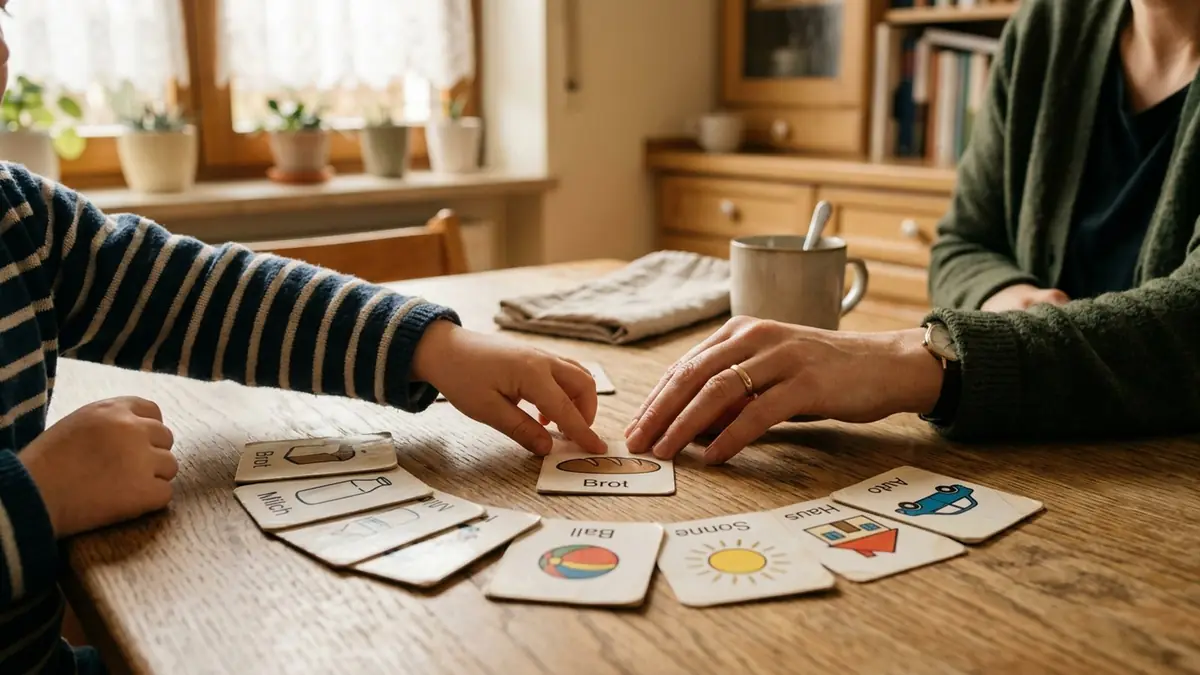
Sometimes showing is better than explaining ten times
Not everything is best conveyed with words.
Especially at the beginning, it can be much easier to do certain routines together.
Show once how something is normally done in your household.
Not:
“I already explained that to you.” (Translated)
But rather:
“Come on, let me show you again how we do this.” (Translated)
This takes the pressure off and, at the same time, prevents mistakes from repeating themselves over and over.
Communication is not only about correction
This point is quickly forgotten in family everyday life.
When something doesn't work, we talk about it.
When everything works?
Then we often say nothing at all.
For the au pair, this can eventually create the impression that conversations with the host family mainly happen when something has gone wrong.
That's why communication is also allowed to be very simple:
“You did that really well today.” (Translated)
“Thank you for remembering that.” (Translated)
“The children had a really great time with you today.” (Translated)
“That really helped me today.” (Translated)
Especially in a foreign language and a new country, positive feedback gives reassurance.
And at the same time it shows your au pair exactly what behaviour you'd like to see.
At eye level – despite clear rules
Host family and au pair have different roles.
Of course you are allowed to set rules, formulate expectations and raise it when agreements are not kept.
Communicating at eye level does not mean letting everything slide.
It means taking the other person seriously.
So sometimes ask too:
“How did you experience the situation?” (Translated)
Perhaps there was a misunderstanding.
Perhaps the au pair understood something differently.
Perhaps there is a reason behind a certain behaviour that you weren't aware of at all.
That doesn't automatically mean you have to change your expectation.
But at least you understand what you're actually talking about.
Not every topic belongs between the front door and dinner
Of course, not every small thing needs a big conversation set up around it.
Many things can be sorted out directly and kindly in everyday life.
Other topics need calm.
If you notice that you're really annoyed right now, or that it's about something that keeps recurring, the moment between two appointments is often not the best time.
After all, an au pair continues to live with you under one roof.
Communication should therefore solve problems – not create new ones on top.
Small misunderstandings are part of it
There probably won't be a single twelve-month au pair stay in which nobody ever misunderstands anybody.
That isn't the goal anyway.
The goal, rather, is that small things stay small.
That whatever is bothering someone gets raised.
That people ask again when something wasn't understood.
That there is not only criticism, but also praise.
And that both sides learn to talk to one another.
Our tip from Besondere Sterne
Don't wait until five small situations have turned into one big problem.
Address things early, kindly and concretely.
Observe instead of judge.
Explain instead of assume.
Show instead of only criticise.
And also say sometimes when something is going really well.
We accompany our host families and au pairs precisely during that important first shared period, including through the challenges that can arise in living together.
Because good matching matters.
But good living together comes about above all when both sides learn to really understand each other.