Au pair and a non-speaking child – how communication can still work well
Speaking is only one of many ways of communicating with one another.
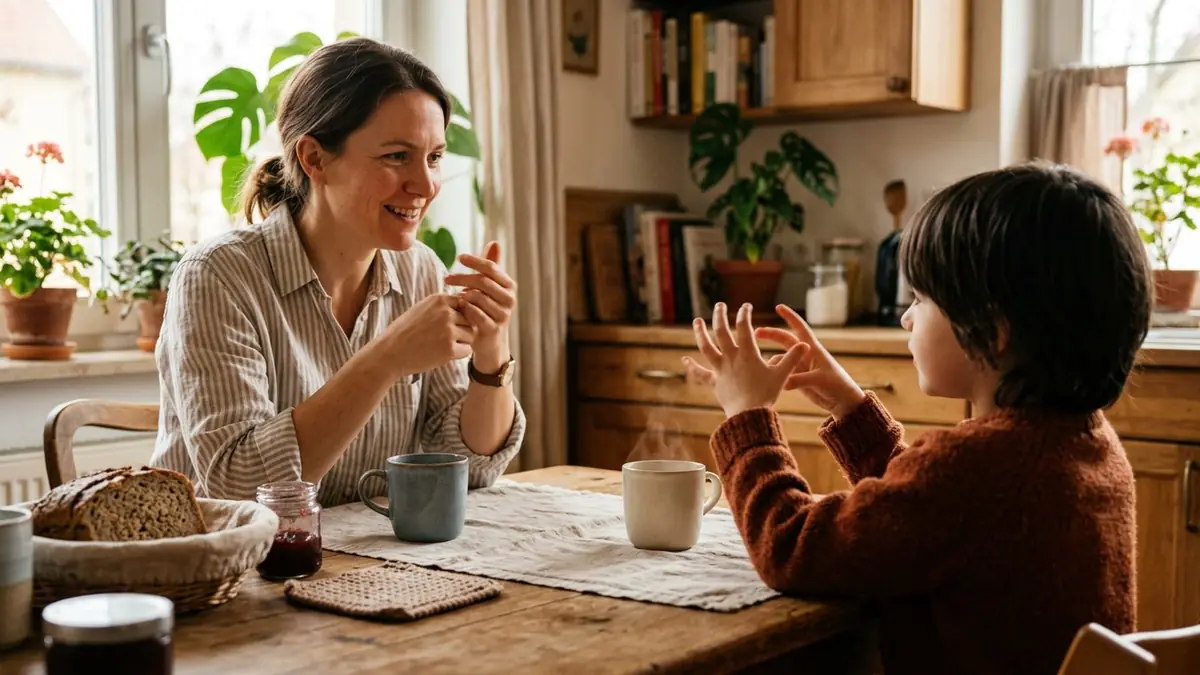
A child who does not speak, or barely speaks, in words still communicates.
Sometimes even very clearly – once you have learnt to look closely.
A look.
A movement.
A particular sound.
Reaching for a hand.
A smile.
Or perhaps turning the head away.
All of this can be a message.
For an au pair who is new to a family with a non-speaking child, a very particular kind of getting to know one another therefore begins:
They learn the language of this one particular child.
Every non-speaking child communicates differently
There is no dictionary you can look things up in:
This movement means hunger.
This sound means tiredness.
This look means “leave me alone for a moment”.
Of course, there are forms of communication and aids that can be learnt.
But alongside these, every family develops its own, very particular understanding of their child over the years.
Parents often know from a single look what is going on.
They hear a particular sound and know immediately:
My child wants something to drink now.
Or:
It's all getting a bit much right now.
For outsiders, none of this is obvious to begin with.
Give your au pair time to learn to read your child
This point matters a great deal to us.
You have known your child for years.
Your au pair, perhaps, for three days.
What has become completely natural to you first has to be learnt by a new person.
So do not expect your au pair to correctly understand every sign within the first week.
Communication with a non-speaking child grows through relationship, observation and time.
The au pair watches closely.
They ask questions.
They experience situations again and again.
And at some point they may understand for themselves:
“Ah, I know that sound. Now she wants something different.”
Or:
“When he does that, he needs a break right now.”
This exact knowledge grows in shared everyday life.
Observing matters more than understanding straight away
A good au pair does not need to master the perfect form of communication on day one.
Far more important to begin with are other qualities:
Patience, attentiveness and genuine interest in the child.
How does the child show joy?
How does the child show rejection?
How does the child draw attention to themselves?
What happens when they become tired?
How can you recognise when things become too much?
What does a particular sound or a particular movement mean?
The au pair may observe and ask the parents questions.
Over time, an ever finer understanding grows out of this.
Unterstützte Kommunikation (augmentative and alternative communication) is part of everyday life
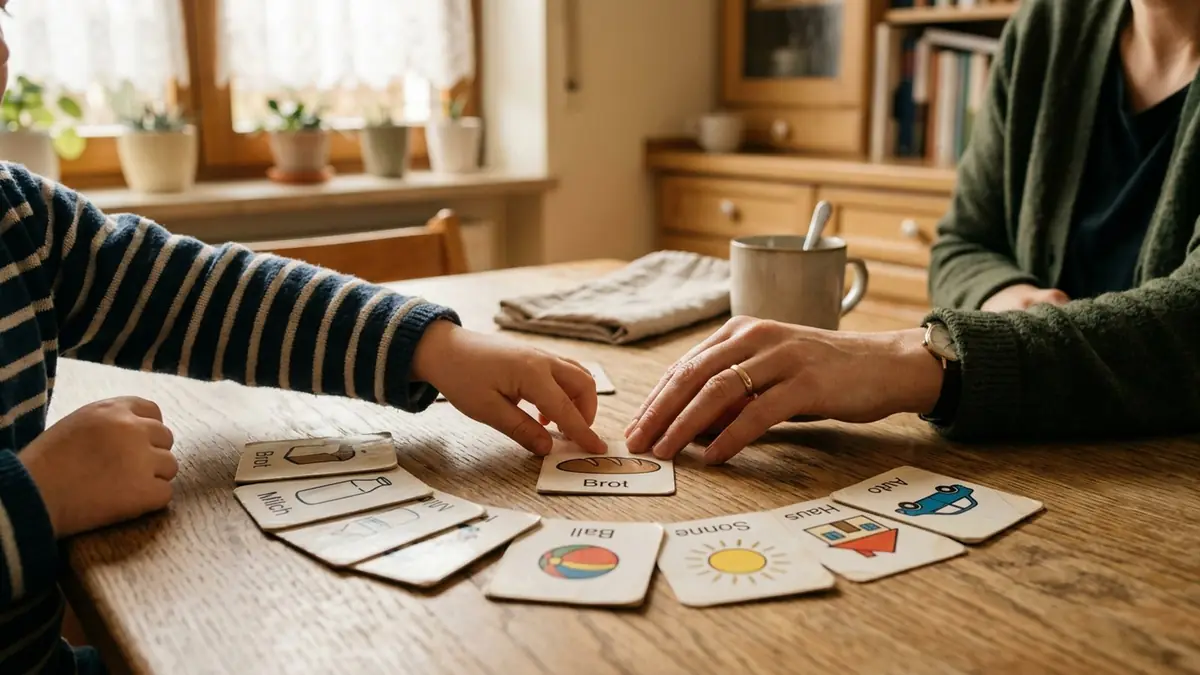
Many families already use forms of Unterstützte Kommunikation.
This can, for example, be symbol cards or picture cards, a talker (a speech-generating communication device), or agreed gestures.
The au pair does not need to invent anything new here.
Quite the opposite.
Their task is to get to know the communication routes the child already uses, and to carry these along as reliably as possible in shared everyday life.
If, for example, the child has learnt to choose between two activities using particular symbols, the au pair should also make use of this option.
This way the child experiences:
My way of communicating also works with this new person.
Sometimes it helps to learn together from professionals
If a child is, for example, accompanied by speech and language therapy or works with Unterstützte Kommunikation, it can, after prior arrangement, make sense for the au pair to come along and watch on one occasion.
Not because they are meant to take on therapeutic tasks.
An au pair is not a trained professional and does not replace speech and language therapy or other therapeutic support.
But they can observe.
Which signs are used?
How is the talker used in an everyday situation?
How do you give the child enough time to respond?
Which communication options should also be offered regularly at home?
This knowledge can then flow quite naturally into shared everyday life.
At breakfast.
While playing.
While getting dressed.
Or when asking:
“What would you like to do today?”
Not speaking for the child – but giving them time
When communication takes longer, something happens quickly:
Adults become impatient.
We ask a question – and answer it ourselves three seconds later.
A non-speaking child in particular may need more time to react or to express their answer.
This is also something an au pair may learn.
Not every pause needs to be filled immediately.
Sometimes good communication simply means:
asking, waiting and watching closely.
Observing turns into understanding
At the start, your au pair will probably often ask:
“What does that mean?”
Perhaps less often after a few weeks.
And at some point you may experience a moment in which your child shows something and the au pair responds quite naturally.
Without you needing to translate.
Exactly then, something special has come into being.
A stranger has become someone who can read your child better and better.
And for a child who does not communicate through spoken language, this can be incredibly valuable:
There is another person who understands me.
Our tip from Besondere Sterne
Do not just give your au pair information about your child.
Give them time with your child.
Show them which communication routes already work. Explain important signs. Let the au pair observe and encourage them to ask questions.
And do not expect, after just a few days, an understanding for which you yourself had years.
An au pair does not need to already bring the language of your child with them.
They need the willingness to learn it.
Look by look. Sign by sign. Day by day.
Because communication does not begin with words.
It begins with someone looking closely – and wanting to understand.