Au pair and sign language – when your child speaks with their hands
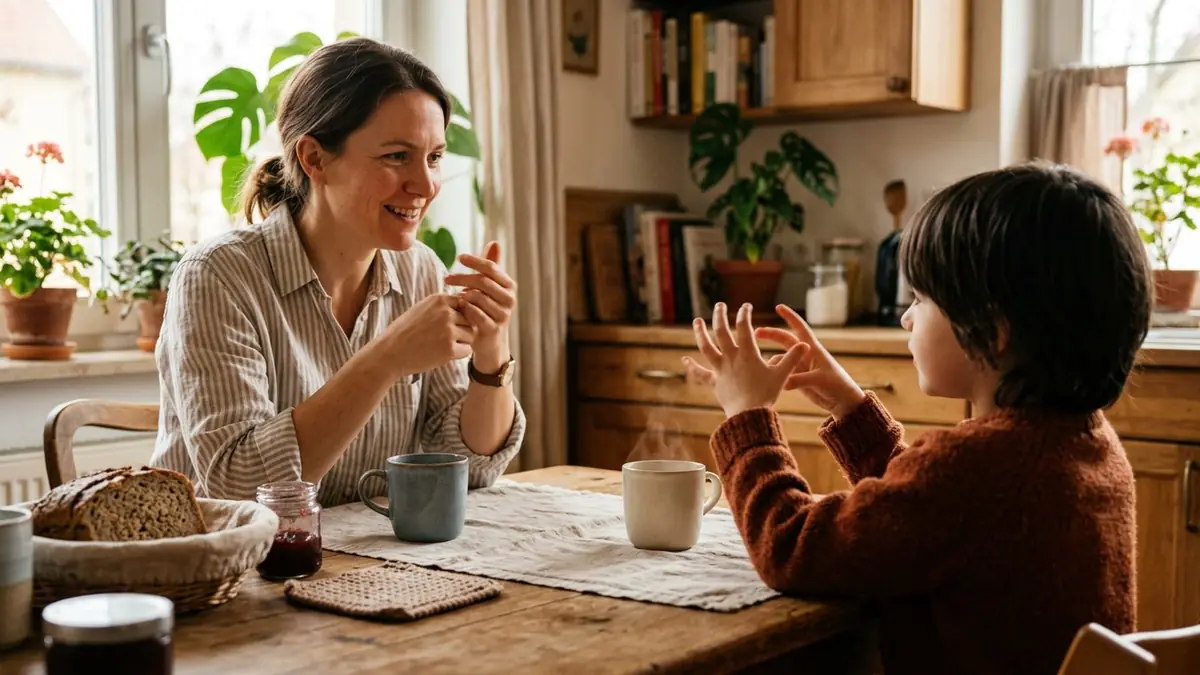
“Our child communicates using signs. Can an au pair even suit us at all?”
This question understandably concerns families.
Because when a child does not communicate through spoken language, or only to a limited extent, a worry quickly arises:
What happens if the au pair doesn't understand my child?
The good news is:
An au pair does not need to know every one of your child's signs on the very first day.
Something else matters far more:
They must be willing to learn them.
A sign is not the same as sign language
Families communicate in very different ways.
Some children use Deutsche Gebärdensprache (DGS, German Sign Language). It is a language in its own right, with its own grammar and its own linguistic system.
Other children use individual supportive signs.
Other families still have developed a highly individual form of communication over the years – made up of particular signs, glances, movements, sounds and gestures.
What matters, therefore, is not assuming any particular system in advance.
What matters is:
How does your child communicate?
This is exactly the language the au pair needs to get to know.
“But our au pair doesn't know sign language”
That does not have to be a reason for exclusion at the outset.
An au pair is not a sign language interpreter and not a professional in Unterstützte Kommunikation (Augmentative and Alternative Communication).
They do not take on any therapeutic or educational tasks.
But they can bring something very important:
Openness. Patience. Attentiveness. And a willingness to learn from your child.
Because for everyday life together, it often does not take hundreds of signs to begin with.
What is needed at first are the signs that matter most for this particular child.
Eat.
Drink.
More.
Finished.
Help.
Again.
Break.
Mum.
Dad.
Play.
Or entirely different signs that carry meaning for your child in daily life.
With every new sign, the chance of understanding one another better grows.
Give your au pair time
This point is perhaps the most important one.
You have lived with your child for years.
You may recognise a glance and know at once what is meant.
You see a small movement of the hand and react automatically.
At some point, this knowledge feels like second nature.
But it has grown over years.
Your au pair is new to this family system.
They cannot learn within a few days what you have learned about your child over many years.
That is why they need time.
Time to observe.
Time to ask questions.
Time to practise.
And also the chance to misunderstand a sign now and then, without immediately feeling unsuited to the task.
Learning the most important signs early on
You can make it easier for your au pair to get started.
Show them, early on, the signs your child uses particularly often in everyday life.
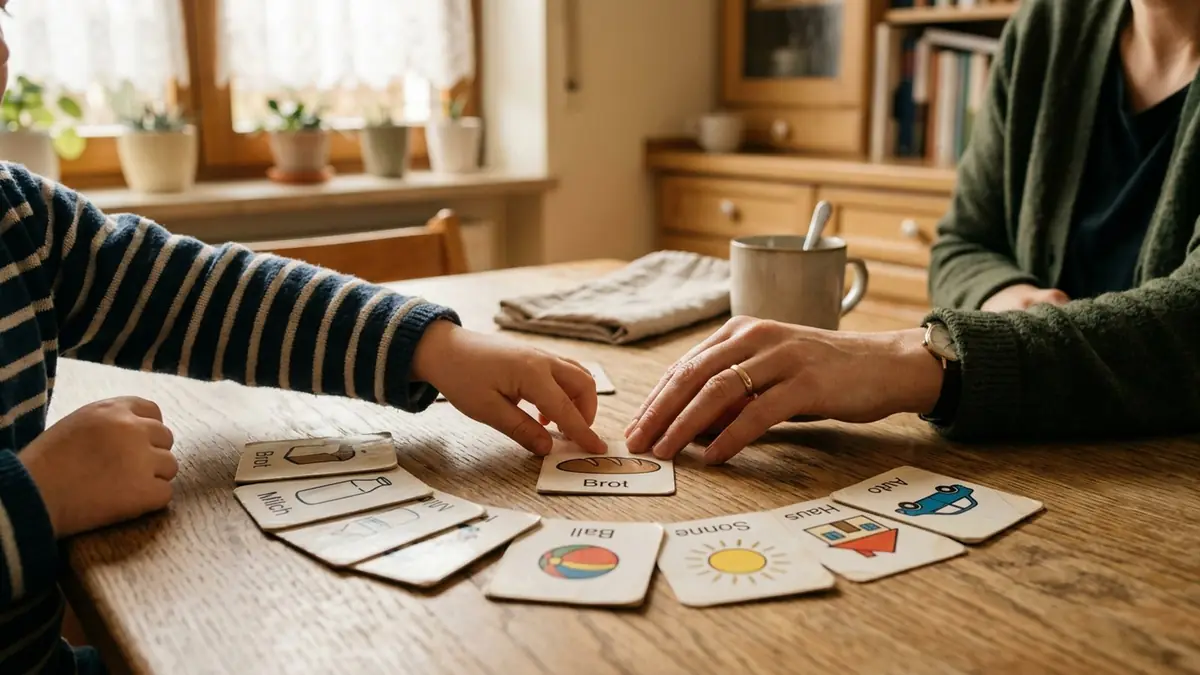
Perhaps there are pictures for this.
Perhaps short videos.
Perhaps a small overview with the most important signs.
Even before arrival, it can be worthwhile giving your future au pair a first impression of how your child communicates.
This is not about completing a full sign language course before arrival.
It is about creating first points of contact.
So that not everything is completely new when they move in.
Learning happens in the middle of everyday life
The au pair learns most of the important signs exactly where they actually need them.
At breakfast.
While getting dressed.
While playing.
At the playground.
While baking together.
At dinner.
The child shows something.
The au pair asks about it.
The parents explain.
Next time, the au pair may already recognise the sign themselves.
And at some point, conscious learning turns into something that feels entirely natural.
Communication grows through repetition.
The child is allowed to become the teacher
And sometimes something particularly lovely emerges from this.
Because it is not only the parents who can show the au pair how the child communicates.
The child themselves can become the teacher too.
Perhaps they show a sign again and again.
Perhaps they correct in their own way.
Perhaps they even take joy in the fact that this new person is trying to learn their language.
This shifts the perspective too.
The child is not the one who “cannot speak”.
They are suddenly the one who can do something the other person still has to learn.
When professional support is already in place
If your child uses DGS or other forms of Unterstützte Kommunikation and is supported, for example, therapeutically or educationally, this knowledge can be helpful too.
With appropriate agreement in advance, the au pair may be able to observe, on occasion, which signs or communication strategies are particularly important in everyday life.
Not to replace a professional.
But to help carry forward, in daily life together, what your child has already learned.
Because communication works especially well when a child can use their familiar signs not only in one particular situation.
But also while eating, playing, getting dressed, or out and about.
Understanding means more than perfect signing
Of course, it would be wonderful if everyone who has contact with a child who communicates in sign language mastered that language perfectly.
In everyday family life, though, understanding often develops step by step.
A sign.
A glance.
A repetition.
A question.
And at some point, a moment when the child signs something and the au pair responds quite naturally.
Without Mum or Dad needing to translate.
This is exactly where a relationship can grow from.
Our tip from Besondere Sterne
Don't look exclusively for an au pair who already masters every one of your child's signs.
Look for someone who wants to learn to understand your child.
Show important signs early on.
Give your au pair support.
Let them observe and try things out.
And above all: give them time.
Because you had years to get to know your child's language.
Your au pair is only just beginning.
They do not need to understand everything on the first day.
But a little more each day.
And at some point, it may no longer be Mum and Dad who have to explain what the child wants to say.
There will be another person in their life who sees their hands – and understands.