Finally the holidays? When 13 weeks suddenly become a challenge

“Finally, the holidays!” (Translated)
For many families, this sentence means sleeping in, holidays, day trips and finally a bit fewer appointments.
For other parents, the real headache only begins with the holidays.
Who is going to look after the children?
Because spread across a school year, around 12 to 13 weeks of school holidays add up in Germany.
Very few parents have that many weeks of annual leave.
And when a child with a disability lives in the family, organising care is often even less straightforward.
Whether it is care during the summer holidays, inclusive holiday care nearby or holiday care for an autistic child: suitable places are rare and often taken quickly.
When the usual care suddenly falls away
During term time, there is a fixed rhythm.
School, nursery, HPT (Heilpädagogische Tagesstätte, a special-needs day centre) or other care arrangements give the day its structure.
And then the holidays begin.
Perhaps there is some inclusive holiday care available – but not for the whole period.
Perhaps the places are limited.
Perhaps the available offer doesn't suit the child's needs.
Perhaps the Förderschule (special school) offers holiday care, but only for part of the school holidays.
Or the usual setting is closed itself.
And suddenly parents have to cover many extra hours of care.
Not for two days.
But sometimes for several weeks at a stretch.
24 hours of family life – every single day
For parents of a child with a disability, holidays therefore don't automatically mean rest.
Sometimes they mean quite the opposite.
The usual structures fall away. The child is at home far more of the time. At the same time, parents may still need to keep working, attend appointments, run the household and, of course, be there for the siblings too.
And at some point the question arises:
How are we supposed to manage all of this at once?
This is exactly where an au pair can make an enormous difference.
Suddenly there are two adults again
Within their agreed working hours, an au pair can support families precisely where the holidays become especially challenging:
in the ordinary, everyday moments.
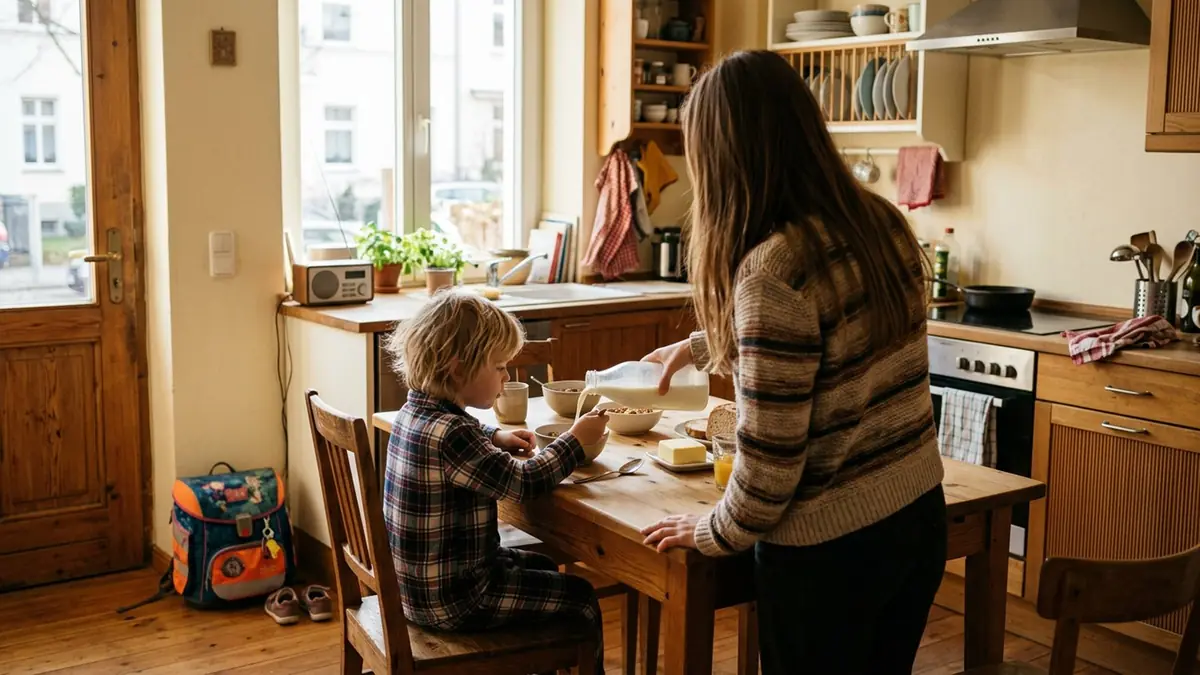
Having breakfast together.
Playing and doing craft activities.
Going out into the garden.
Spending a morning at the playground.
Baking together.
Going for a walk.
Or simply spending a relaxed holiday day at home.
The au pair already knows the children and is part of the family's everyday life.
That means six weeks of summer holidays don't have to be covered by Mum or Dad alone, every single day.
And what do the siblings actually want?
This point is quickly forgotten.
Because the holidays are not just time without childcare.
For children, the holidays are something special.
Perhaps the sibling has been wanting to visit that one museum for ages.
Perhaps they want to go to the swimming pool.
Perhaps the mountain hike has been on their wish list for months.
Or they want to go on a trip that simply isn't suitable for their brother or sister with a disability.
What does a family do then?
Often the answer is:
Then we just won't do it.
Not because the parents don't want to.
But because they can't split up.
With an au pair, two options suddenly open up
This is exactly where family life can change.
Perhaps the au pair stays at home with the child with a disability.
The two of them spend a lovely day in the garden, play, do craft activities, or go to the familiar playground.
And Mum and Dad?
They finally go on the hike with the siblings that everyone has been talking about for months.
Next time, it might be exactly the other way round.
The au pair does something with the siblings, while Mum or Dad spends a special day with the child with a disability.
Not every family member has to do the same thing all the time any more.
Holidays are allowed to hold different needs
This is incredibly valuable, especially with several children.
Because siblings don't automatically share the same interests.
And a child with a disability may have quite different needs, abilities or limits than their siblings.
One child wants action.
The other needs a quiet day.
Holiday care for an autistic child lives above all on the same routines, the same faces and few surprises.
One wants to hike for five hours.
The other loves their afternoon in the garden.
Without extra support, the family often has to find a compromise.
With an au pair, you can split up.
And suddenly, a holiday day is allowed to look different for each child.
Parents need a bit of breathing space in the holidays too
And then there is someone else whose needs are often placed right at the back when planning the holidays:
the parents.
Six weeks of summer holidays don't mean parents can plan activities every single day for six weeks.
They, too, need a break now and then.
Perhaps the au pair takes over one morning and goes out with the children.
Perhaps Mum or Dad gets to sleep in for once.
Perhaps there are two hours in which nobody wants anything from them.
Or they can simply get something done in peace.
That sounds like small things.
But after several weeks of holidays, precisely these small breaks can become incredibly valuable.
When “how are we going to manage this?” becomes holidays again
An au pair does not replace professional holiday care for children with a disability and does not take on nursing or therapeutic tasks.
Whether holiday care at the Förderschule or through a Familienentlastender Dienst (FED, family relief service) exists differs from region to region.
But they bring something that can be especially valuable during long holiday weeks for families:
time, familiarity and, once again, an extra pair of hands.
At Besondere Sterne, we place au pairs with families who are looking for precisely this kind of support in their everyday life.
Someone who already knows the children.
Who doesn't need to be newly organised for every single holiday day.
Who is already there in the morning.
And who can help make sure that one child's needs don't automatically mean everyone else has to step back.
Because the holidays shouldn't mean, for six weeks straight:
“How on earth are we going to organise this?”
Even in a family with a child with a disability, they are allowed to be, once again, what children look forward to all year long:
Holidays.