An au pair for several children – can that work?
“We have several children, and one of them has a disability. Can an au pair really support us in a meaningful way?” (Translated)
Families ask us this question again and again.
It's easy to imagine that a choice has to be made:
Should the au pair mainly be there for the child with a disability? Or for the siblings? Who gets their time? And how is this supposed to work when all the children have different needs?
Yet this is exactly where one of an au pair's great strengths lies:
They aren't only there for a single child. They support the family wherever they are needed in everyday life.
Sometimes this child needs more – sometimes the other
Family life isn't the same every day.
One afternoon, the child with a disability needs a lot of support and company. The next day, a sibling has an important appointment. Another time, one of the children simply wants some time alone with Mum or Dad.
With an extra person in everyday life, possibilities suddenly open up that barely existed before.
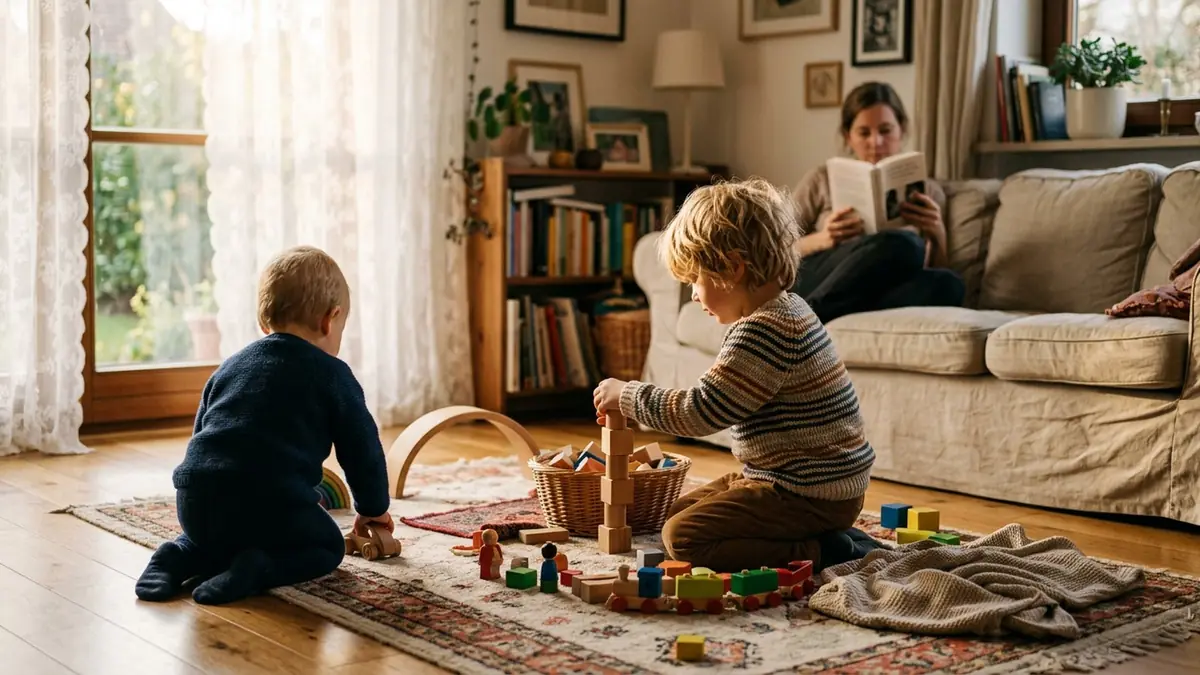
While the au pair plays with the child with a disability or accompanies them through the day, you can focus entirely on a sibling.
And next time, you swap it round.
You spend dedicated time with your child with a disability while the au pair takes the siblings to the playground, does crafts with them, or plays at home.
The focus is allowed to shift.
It's not one child who gets support – the family gets support
This is an important distinction.
An au pair doesn't have to be assigned exclusively to the child with a disability.
They can be there for all the children.
In the morning, they might help get the siblings ready for school and nursery.
In the afternoon, they accompany the child with a disability through the day.
Later, they play with the siblings while Mum or Dad attend an appointment or take care of something else.
The support can adapt to whatever your family needs at that moment.
Two adults create two possibilities
Anyone with several children knows these situations only too well:
Two children need something at the same time.
One child wants to go to the playground, the other needs quiet.
One needs to be picked up while the other needs support at home right then.
One child has an appointment, and the siblings understandably don't want to come along yet again.
Alone, parents constantly have to decide:
Who has to wait today?
With an au pair, there are suddenly two adults.
And one possibility becomes two.
The child with a disability benefits
Over the months, an au pair can become a trusted, additional reference person for a child with a disability.
They get to know the routines, spend regular time with the child, and increasingly understand what brings them joy and how the family's everyday life works.
Of course, an au pair does not replace a carer, nor therapeutic or educational professionals.
Their strength lies in everyday life:
playing, accompanying, keeping the child occupied, supporting, and simply spending time together.
The siblings benefit
At the same time, more space opens up for the siblings.
Sometimes they have the au pair all to themselves and gain a new playmate.
Sometimes the au pair takes on part of the family's daily routine, which creates the chance for Mum or Dad to spend dedicated time with them.
That way, attention doesn't constantly have to be missing in the place where another child currently needs more support.
And the parents benefit too
In this model, parents don't always have to be the ones filling every gap.
When another person regularly shares the load, it can ease the whole family's everyday life.
Perhaps you can take one child to an appointment without bringing everyone else along.
Perhaps there's time left for a coffee, a walk, or some shopping on your own.
Or you can simply focus on a single child for once, without being needed in three other places at the same time.
It's not about splitting attention exactly evenly
Family life can't be broken down into perfect blocks of hours.
Three hours for this child on Monday, two hours for the next on Tuesday – that's not how families work.
And that's exactly why an au pair can fit so well into everyday life with several children.
The support is allowed to change.
Depending on who needs whom at that moment.
Today, your child with a disability needs more support and company.
Tomorrow, the sibling needs attention.
And the day after, perhaps you simply need someone to lend a hand.
An au pair from Besondere Sterne is there for the family
At Besondere Sterne, we don't place au pairs with the idea that they are responsible for a single child alone.
We look at the family as a whole.
Which children live in the household? Where is support needed? What needs does the child with a disability have? And which au pair might fit well into this family's everyday life?
Because ultimately, it shouldn't only be one family member who benefits from the support.
The value it adds is for the whole family.
For the child with a disability.
For the siblings.
For Mum and Dad.
And above all, for family life together.
Because sometimes a family doesn't need someone for one child.
It simply needs two more hands for everyone.