The au pair and driving: is the au pair allowed to drive the children?
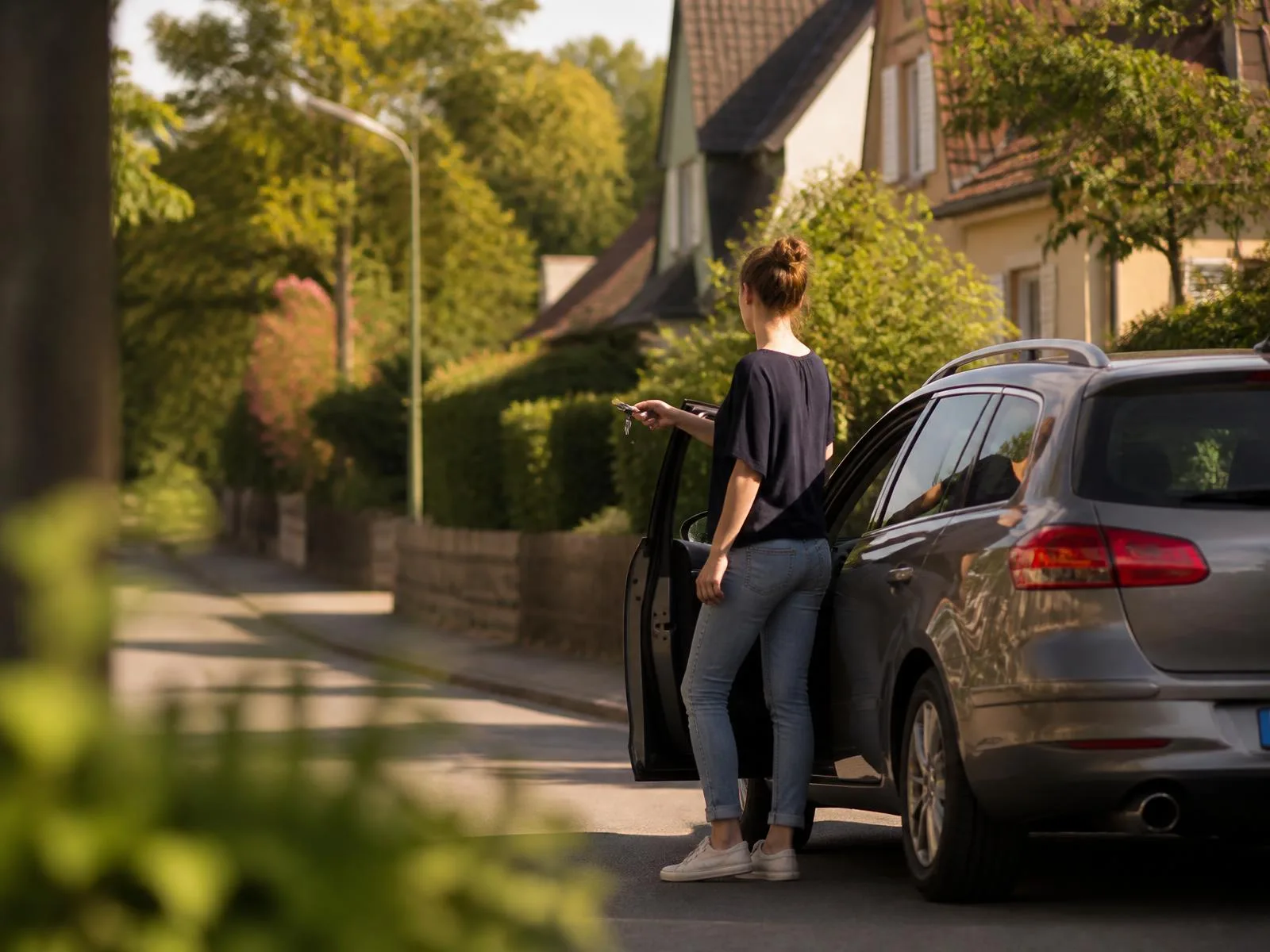
“Our au pair has a driving licence – so surely they can take the children to school in the morning and to therapy in the afternoon.”
In principle, an au pair with a driving licence can also take on driving duties for the children. This can be a huge relief, particularly for families with several children or a child with a disability.
School, nursery, therapy, music school, children's gymnastics, football or riding therapy – an astonishingly large part of everyday family life often consists of getting children from one place to the next.
Even so, host families shouldn't underestimate one important point:
A foreign driving licence doesn't automatically mean that an au pair can move safely and confidently in German road traffic.
And sometimes the best solution is actually something quite different: Mum or Dad continues to do the driving – while the au pair keeps everyday family life running at home in the meantime.
Is an au pair allowed to drive in Germany?
In principle, yes, provided the au pair holds a driving entitlement (Fahrerlaubnis, i.e. a licence to drive) that is valid in Germany for the vehicle in question.
With a foreign driving licence, its validity depends, among other things, on which country issued it.
For driving licences from countries outside the EU or the EEA, it is particularly important to look into their validity in Germany in good time. Often these licences can initially be used for a limited period after the person has established their main residence in Germany.
Which rules apply in a specific case should be checked individually.
Host families with Besondere Sterne receive further information and guidance from us on this, so they know which points need to be considered and clarified in good time regarding their au pair's foreign driving licence.
A driving licence alone says nothing about actual driving practice
If driving matters to your family, you should discuss this topic in detail with the au pair as early as the getting-to-know-you stage.
The question
“Do you have a driving licence?”
isn't enough on its own.
Ask instead:
How long have you had your driving licence?
How often do you actually drive?
Do you drive daily, several times a week, or only occasionally?
Do you mainly drive in the countryside, or also in a larger city?
How much traffic is there there?
Have you driven on motorways before?
Do you drive automatic or manual?
What size of car are you used to?
Because there is a considerable difference between “I've had a driving licence for three years” and “I've driven a car every day for three years”.
Driving in Germany can be completely new for the au pair
Think about where your au pair comes from.
Perhaps their home country drives on the left.
Perhaps they have mainly driven on quiet roads until now.
Perhaps they don't know certain German road signs.
Rules and traffic situations that are completely second nature to us can be new to a young person from another country.
Priority to the right, cycle lanes, roundabouts, trams, motorways, heavy rush-hour traffic or complicated city centres – all of this first has to be learned.
On top of that, there's an unfamiliar car.
And then possibly two children are meant to sit in the back seat as well.
That is a great deal of responsibility.
That's why the same principle applies to driving as to an au pair's induction as a whole:
Show and practise first – then hand over responsibility.
The first trial drives should always be without the children
After arrival, we first recommend a few trial drives with the au pair – without the children.
Let the au pair get to know the family car first.
Is it automatic or manual?
How big is the vehicle?
Where are the lights, windscreen wipers and hazard lights?
How does the reversing camera work?
How does the car behave when parking?
After that, you can drive short routes together.
To the supermarket.
To school.
To nursery.
To the sports club.
To therapy.
This also lets you see just how confidently the au pair actually drives.
Practise the important routes together
If your au pair will later be regularly picking a child up from school, drive exactly that route together several times.
Show them where the child waits.
Where is parking allowed?
Where must you not stop?
Which school entrance is the right one?
Is there a confusing junction?
What does the traffic situation look like in the morning or afternoon?
The same applies to nursery, therapy or the club.
What has become routine for you after years must first be learned by the au pair.
Only once everyone feels confident do the children join the ride
There is no reason to put the children in the back seat as early as the first or second drive.
First, observe:
Does the au pair drive calmly and with foresight?
Do they know the traffic rules?
Can they operate the vehicle safely?
How do they react in heavier traffic?
Can they park safely?
And very importantly: does the au pair themselves feel confident?
An au pair should never feel that they have to drive even though they don't yet trust themselves with the route or the traffic situation.
Only once the host family and the au pair have a good feeling about it should the children come along.
Explain car seats and safety precisely
Before the au pair drives the children, the correct securing of the children must also be discussed and demonstrated.
Which child sits where?
Which car seat belongs to which child?
How is the child correctly strapped in?
How is the car seat used correctly?
Especially with a child with a disability, there may be additional particularities to consider.
Perhaps the child needs a special seat or more support getting in and out.
This, too, is part of the induction.
Don't assume that an au pair automatically knows how your child's car seat works.
Show them. Let them try it themselves. Check it together at the start.
Au pair and child with a disability: driving duties can enable a great deal of participation
For families with a child with a disability, driving duties can be especially valuable.
Speech therapy, occupational therapy, riding therapy, music school, children's gymnastics, sports club or other leisure activities may all be in quite different places.
If the au pair drives confidently, they can take on some of these journeys.
Perhaps they take the child to riding therapy and accompany them there.
Perhaps they drive to children's gymnastics and stay on as leisure-time support.
Or they pick the child up again after a leisure activity.
This means an au pair can not only relieve the parents but potentially also give the child more free time and participation.
But: the au pair doesn't have to drive at all
This point is sometimes forgotten.
An au pair with little driving practice is not automatically less helpful to a family.
And you don't necessarily need to turn your au pair into a confident driver in German city traffic if that doesn't feel right to you.
Perhaps, after a few trial drives, you find:
“I'd rather keep driving my children myself.”
That is entirely fine.
Because relief doesn't necessarily mean:
The au pair has to take on exactly the task that Mum or Dad used to do.
Sometimes a different division of tasks is even much more pleasant.
You drive – the au pair frees you up at home
Let's imagine a typical afternoon.
Your child with a disability has riding therapy.
In the past, that might have meant:
Packing up all the children, driving there together, keeping the siblings occupied during the appointment, then driving everyone home again – where the rest of everyday family life is waiting.
With an au pair, the situation can look quite different.
Mum drives the child to riding therapy.
The au pair stays at home and looks after the siblings.
Or Dad drives one child to football training while the au pair shapes the afternoon with the other children in the meantime.
Suddenly, the whole family no longer has to attend every appointment.
That, too, is an enormous relief.
A lot can happen at home in the meantime
Depending on the agreed weekly schedule, the au pair can not only look after the siblings during your absence but also take on light tasks in everyday family life.
Perhaps the children's room gets tidied up together.
The children's laundry is taken out of the dryer, folded and put away in the cupboards.
The dishwasher is emptied.
The table is laid for dinner.
Potatoes or carrots are already prepared for a simple meal.
Or the children have already eaten, had a bath, and are sitting in their pyjamas in their room by the time you get back.
And then you come home from therapy and think:
How lovely – we don't have to start again from zero.
That, too, is exactly what au pair support looks like.
Small task lists can help, especially at the start
For this to work, the au pair obviously needs to know what is expected during this time.
Particularly during the induction period, a small task list can be helpful.
Not:
“Just do a bit of something while I'm away.”
But specifically:
“I'll be at therapy with Emma for about two hours. Please play with Paul first. Afterwards you can tidy his room together. Then you can fold the children's laundry from the dryer and please lay the table for dinner.”
This gives the au pair orientation.
Of course, all tasks must remain within the normal childcare duties and light household tasks of an au pair.
Sometimes sharing is better than replacing
This thought matters particularly for families with several children.
The au pair doesn't have to replace Mum or Dad.
They are an additional person in everyday family life.
Perhaps you actually want to deliberately accompany your child with a disability to therapy yourself.
Perhaps you enjoy the drive together and want to speak with the therapist.
In that case, the au pair shouldn't take this task away from you at all.
Instead, they can make sure that you can attend this appointment with your child without having to organise three other things at the same time.
Mum drives to therapy.
The au pair looks after the siblings.
Dad drives to football.
The au pair prepares dinner with the younger child.
Mum picks a child up from music school.
Meanwhile, the au pair supports homework at home.
Relief can come about in quite different ways.
Definitely check the motor insurance beforehand
If the au pair is going to drive the family car, the motor insurance must also be clarified before the first drive.
Host families should check whether the au pair is insured as a driver, or needs to be added to the circle of authorised drivers.
Particularly with young drivers, special conditions or additional costs may apply.
So don't rely on:
“The car is insured, so of course everyone is automatically allowed to drive it.”
Clarify the specific situation directly with your insurer.
Is the au pair also allowed to use the car privately?
It is up to the host family to decide whether the au pair may use the family car in their free time.
There is no automatic entitlement to private use.
Some families allow private trips when they don't need the car themselves.
Others make the vehicle available exclusively for agreed journeys with the children.
Both can work.
What matters are clear rules.
If private trips are allowed, it should be discussed, for example, who pays for fuel, whether longer journeys are permitted, whether friends may come along, where the vehicle is parked, and how parking or speeding tickets are handled.
The more clearly these things are settled in advance, the fewer misunderstandings arise later.
Phone and navigation: safety comes first
Phone use should also be discussed.
Of course, the au pair can use their smartphone for navigation.
However, the route should be set before starting the journey, and the phone should be securely mounted.
Reading messages, replying to voice messages or holding the phone while driving is not an option – especially not with children in the car.
Driving duties and alternative tasks count as working time
If the au pair drives a child to school, therapy or a club as part of their duties, that time counts towards the au pair's working time.
The same naturally applies if they look after the siblings at home in the meantime, fold the children's laundry, or take on other agreed au pair tasks.
Here too, the general limits apply: a maximum of six hours a day and 30 hours a week.
An au pair with a driving licence is useful – but not essential
An au pair who drives confidently can be a great relief for a family.
But an au pair doesn't necessarily have to drive the children to be enormously helpful in everyday family life.
Sometimes the best solution is:
You keep driving yourself – and your au pair makes sure everything keeps running at home in the meantime.
The siblings are looked after.
The children's laundry is folded.
The table is laid.
Dinner is prepared.
The homework is done.
And when you get home, the whole of everyday family life isn't still waiting for you.
That's exactly why it's worth not only asking:
“Can my au pair drive my children?”
But also:
“How can we, as a family, divide things up with our au pair so that our everyday life as a whole becomes easier?”
Because sometimes the greatest relief isn't handing over a task completely.
Sometimes it's simply having an extra person taking something on elsewhere in the meantime.
Note: different rules apply to foreign driving entitlements depending on the issuing country. The specific validity should be clarified with the relevant driving licence authority (Fahrerlaubnisbehörde) before driving in Germany. Host families with Besondere Sterne receive further information on this from us.